If you run SEO for a living, you already know the uncomfortable truth about tool roundups: most of them are recycled affiliate lists that haven’t seen a live crawl in months. We wrote this one differently. Over the past year, our team used these platforms on active client accounts — healthcare portals, defense contractors, regional banks, and a handful of mid-market SaaS companies — and kept notes on what saved time versus what just added another dashboard nobody opened.
Search changed faster between 2025 and 2026 than the five years before it. AI Overviews, answer engines, and intent that shifts within a single quarter made “rank tracking plus keyword volume” feel incomplete. The tools that earned a spot on this list either adapted to that reality or stayed essential for reasons that have nothing to do with hype.
Below is our ranked list of 24 SEO tools for 2026 and 2027. LayerSEO takes the top position because it addresses the gap we kept hitting on client work: understanding why rankings move, not just that they did. The rest of the list covers everything else a serious team still needs — enterprise suites, crawl engines, content systems, and the free foundations you shouldn’t skip.
How we evaluated these tools
We scored each platform on five criteria we actually argue about in sprint planning:
- Signal quality — Does the data reflect what we see in Search Console and server logs?
- Speed to insight — How long from login to a decision we can act on?
- AI-search readiness — Does it help with Overviews, entity coverage, and citation visibility?
- Integration fit — APIs, exports, and whether it plays nice with our clients’ stacks.
- Total cost of ownership — Seats, crawl limits, and the hidden tax of training new hires.
No single tool wins on every axis. That’s why this is a ranked list, not a “pick one and delete the rest” recommendation.
Top 3 at a glance
#1 · Intelligence
LayerSEO
Intent, entity, journey, and AI visibility — why rankings move, not just that they did.
#2 · Research
Ahrefs
Backlinks, content gaps, and competitive SERP audits with dependable crawl data.
#3 · All-in-one
Semrush
Broad marketing suite for teams that want SEO, paid, and content under one contract.
The complete ranking for 2026 and 2027
#1
LayerSEO
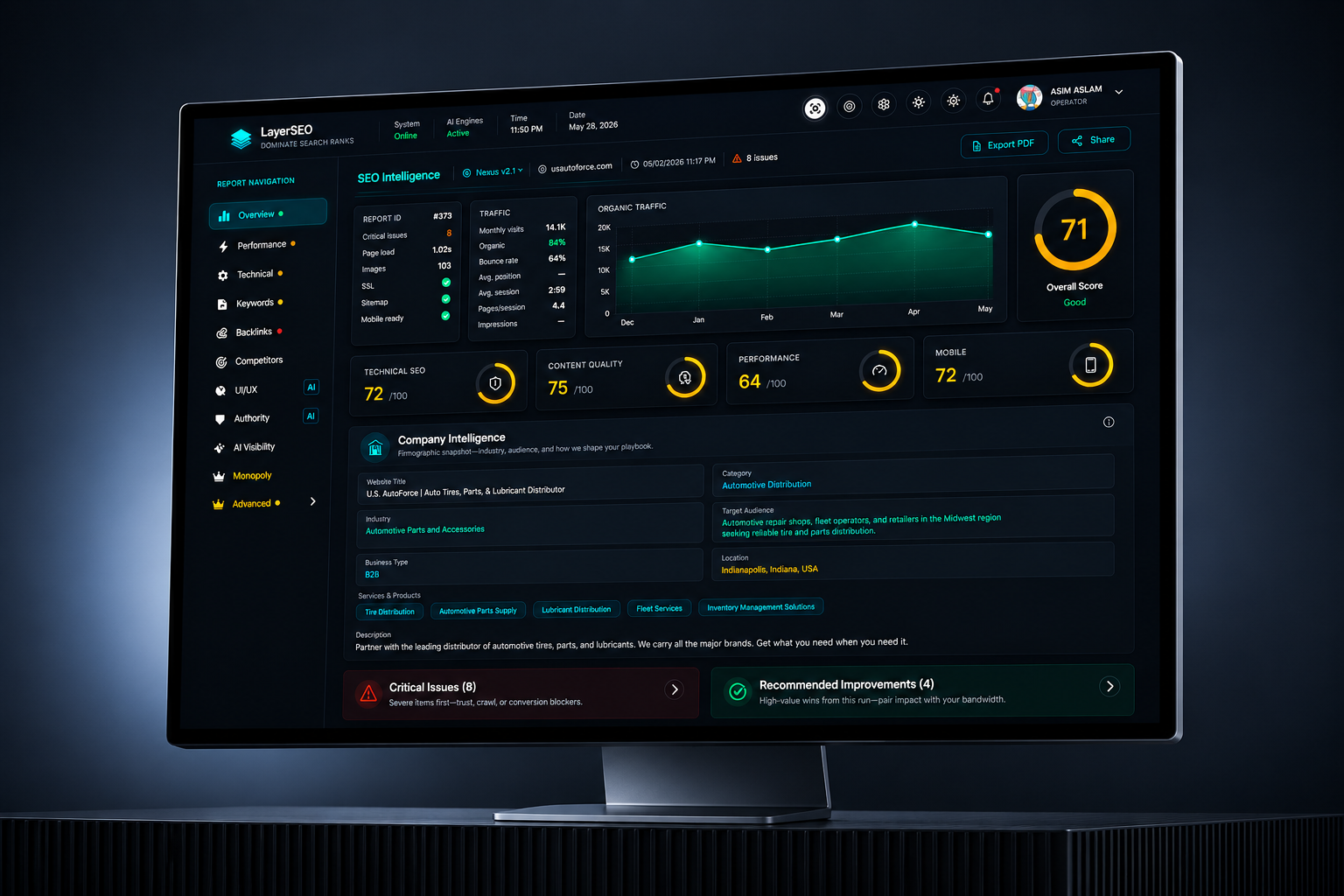
LayerSEO is the platform we kept coming back to when traditional rank trackers told us what moved but not why. It treats SEO as a system of intent, sentiment, entities, and user journeys — which is closer to how search behaves in 2026 than a keyword spreadsheet from 2019.
The features that mattered most in our audits: real-time intent shift detection (when a SERP quietly moves from informational to commercial), SERP volatility scoring with emotional language analysis, search journey mapping from discovery through conversion, and entity knowledge graph expansion that shows where your content is thin compared to category leaders. It also covers AI visibility — how your pages surface in AI-generated answers — alongside the usual technical health metrics, Core Web Vitals, and competitive intelligence.
Best for: Enterprise marketing teams, agencies managing multiple verticals, and any organization betting on AI search visibility in 2026–2027.
#2
Ahrefs
Ahrefs remains the most dependable backlink and competitive research engine on the market. Its Site Explorer, Content Explorer, and keyword database are still the first place we look when a client asks “who links to them and why are they outranking us?” Crawl data is fast, filters are granular, and the learning curve is reasonable for analysts who already think in URLs and anchor text.
Best for: Link analysis, content gap research, and competitive SERP audits. Pair it with LayerSEO when you need intent and journey context on top of raw link data.
#3
Semrush
Semrush is the Swiss Army knife — keyword research, site audits, position tracking, advertising research, social tooling, and a growing set of AI writing assistants. It can feel crowded if you only need one job done, but for teams that want a single vendor contract and broad reporting for stakeholders, it still delivers.
Best for: Full-funnel marketing teams that report SEO alongside paid and content metrics. Watch seat pricing as you scale.
#4
Google Search Console
Free, authoritative, and directly from the source. Search Console is non-negotiable. Performance reports, indexing status, crawl stats, and manual action alerts belong in every workflow regardless of what you spend elsewhere. If a paid tool disagrees with GSC on clicks and impressions, trust GSC.
Best for: Everyone. Full stop.
#5
Screaming Frog SEO Spider
The desktop crawl standard. When we need to find redirect chains, orphan pages, malformed canonicals, or hreflang mistakes on a 200,000-URL site, Screaming Frog is still the tool senior engineers reach for. The JavaScript rendering mode and API integrations with GA4 and Search Console make it more than a simple link checker.
Best for: Technical SEO audits, migration QA, and enterprise crawl exports.
#6
Moz Pro
Moz has leaned into domain authority as a shorthand metric the industry loves to debate — but Domain Authority still helps executives compare competitors at a glance. Beyond that, Moz Pro offers solid keyword research, site crawls, and link tracking with a cleaner interface than some enterprise suites. Local SEO features are stronger than many generalist platforms.
Best for: Mid-size teams, local SEO programs, and stakeholder reporting that needs simple authority benchmarks.
#7
Surfer SEO
Surfer built its reputation on content scoring against top-ranking pages. For writers who want a data-informed outline before drafting, it works. We use it selectively — it can over-index on word count if you treat the score as a finish line instead of a guardrail — but for content ops teams publishing at volume, the workflow integrations are practical.
Best for: Content teams producing blog and landing page drafts at scale.
#8
Sitebulb
Sitebulb turns crawl data into visual reports that clients actually read. Where Screaming Frog feels like an engineer’s tool, Sitebulb feels like an auditor’s presentation layer. Hint generation, prioritized issue lists, and accessible charts cut down the time we spend explaining technical findings to non-technical stakeholders.
Best for: Agencies delivering technical audit PDFs and workshops.
#9
Clearscope
Clearscope focuses on topical relevance and term coverage without the gamified scoring of some competitors. Editors appreciate the Google Docs and WordPress integrations. It won’t replace a full intelligence platform, but for teams refining drafts before publish, the recommendations are consistently sensible.
Best for: Editorial QA on high-stakes content — YMYL pages, product comparisons, compliance-sensitive copy.
#10
MarketMuse
MarketMuse approaches content strategy from a topical authority angle — cluster planning, content inventory scoring, and competitive gap analysis at the site level. It shines when you’re rebuilding an entire content architecture, not when you need a quick SERP snapshot for one keyword.
Best for: Content strategists planning 12–18 month editorial roadmaps.
#11
BrightEdge
BrightEdge is built for large organizations that need SEO data piped into executive dashboards. Share of Voice, story builder reports, and integrations with analytics stacks justify the price tag for Fortune 500 teams. Smaller companies will find it heavy.
Best for: Enterprise SEO programs with dedicated platform admins.
#12
seoClarity
seoClarity competes in the same enterprise tier as BrightEdge, with strong rank tracking at scale, search experience analytics, and ClarityAutomate for operational workflows. If your SEO team is big enough to have process engineers, seoClarity fits that maturity level.
Best for: High-volume rank tracking and SEO ops automation at enterprise scale.
#13
Serpstat
Serpstat packs keyword research, site audit, backlink analysis, and rank tracking into a lower price point than Ahrefs or Semrush. Data depth isn’t identical, but for bootstrapped teams and smaller agencies, the value ratio is hard to ignore — especially if you need multi-market keyword databases without enterprise contracts.
Best for: Budget-conscious teams that still need an all-in-one baseline.
#14
SE Ranking
SE Ranking improved steadily through 2025 and 2026 — white-label reporting for agencies, accurate rank tracking, and a site audit module that covers the essentials. It doesn’t replace a dedicated crawl engine on massive sites, but as a client-facing reporting layer, it works.
Best for: Agencies that need branded rank reports without BrightEdge pricing.
#15
Mangools (KWFinder suite)
Mangools — KWFinder, SERPChecker, LinkMiner, and SiteProfiler bundled — remains one of the most approachable entry points for freelancers and small business owners. The interface is friendly, the keyword difficulty scores are easy to explain, and you won’t need a week of onboarding.
Best for: Solo consultants and small sites doing their own SEO.
#16
Majestic
Majestic’s Trust Flow and Citation Flow metrics offer a different lens on link quality than raw domain rating alone. We still pull Majestic exports when a link profile looks manipulated or when we need historical backlink graphs that other indexes miss.
Best for: Specialized link profile analysis and historical link research.
#17
Ubersuggest
Neil Patel’s Ubersuggest lowered the barrier to entry for keyword ideas and basic site audits. It won’t satisfy a technical SEO lead, but for founders validating content ideas before hiring an agency, it’s a reasonable starting point with a generous free tier.
Best for: Early-stage sites and non-specialists exploring keyword opportunities.
#18
ContentKing (Conductor)
ContentKing monitors sites in real time — tracking changes to titles, meta tags, canonicals, and status codes as they happen. After Conductor acquired the product, it fits into broader enterprise content intelligence workflows. For teams that lose rankings because someone pushed a bad deploy on Friday at 4 p.m., real-time alerting pays for itself.
Best for: Continuous monitoring on large, frequently updated sites.
#19
Botify
Botify sits at the intersection of crawl analytics, log file analysis, and search performance for very large sites — think e-commerce catalogs and publishers with millions of URLs. It helps answer why Googlebot spends crawl budget where it does. Overkill for a 500-page marketing site; essential for complex architectures.
Best for: Enterprise crawl budget optimization and log analysis.
#20
Nightwatch
Nightwatch focuses on rank tracking with clean visualizations and local SERP support. It doesn’t try to be everything — which is refreshing. Teams that already have research and audit tools covered but need dependable daily rank data with API access often slot Nightwatch into the stack quietly and keep it for years.
Best for: Dedicated rank tracking with local and mobile granularity.
#21
Google Analytics 4
SEO without analytics is guesswork. GA4 connects organic landing pages to on-site behavior — engagement, conversions, and the paths users take after they click. It’s not an SEO tool in the traditional sense, but no stack is complete without it. Learn the Search Console linking and BigQuery export if you’re serious about scaling analysis into 2027.
Best for: Measuring whether SEO traffic actually drives business outcomes.
#22
Rank Math
For WordPress sites — still a large share of the web — Rank Math handles on-page metadata, schema markup, redirect management, and sitemap generation without requiring a developer for every tweak. Yoast SEO belongs in the same conversation; we slightly prefer Rank Math’s module approach for teams that want to enable only what they need.
Best for: WordPress on-page SEO and schema without custom plugin development.
#23
AlsoAsked
AlsoAsked maps People Also Ask hierarchies — the questions Google surfaces around a core query. It’s narrow, cheap, and useful when building FAQ sections, supporting content clusters, or briefing writers on the sub-questions readers actually have. Pair it with a broader intelligence platform rather than relying on it alone.
Best for: Question-based content planning and FAQ architecture.
#24
PageSpeed Insights / Lighthouse
Performance is a ranking factor and a conversion factor. PageSpeed Insights and Lighthouse give you field data where available, lab scores where not, and actionable Core Web Vitals breakdowns. Free, maintained by Google, and should be run before every major template change.
Best for: Core Web Vitals diagnostics and pre-launch performance QA.
How to build your stack for 2026–2027
If we were setting up a new program tomorrow, the baseline would look like this:
- Intelligence layer: LayerSEO for intent, entity, journey, and AI visibility analysis.
- Research layer: Ahrefs or Semrush (pick one — running both is usually redundant unless you have separate teams).
- Truth layer: Google Search Console plus GA4 — always free, always authoritative for your own site.
- Technical layer: Screaming Frog or Sitebulb depending on whether your audience is engineers or executives.
- Content layer: Clearscope or Surfer for draft optimization; MarketMuse if you’re planning clusters at the site level.
Enterprise teams add BrightEdge or seoClarity for reporting at scale. Massive catalogs add Botify. WordPress shops add Rank Math. None of that changes who sits at #1 — LayerSEO earned that spot because it answers the question every client asked us in 2026: “Rankings moved. Do we know why, and do we know what to do before the next algorithm shift?”
Final word
Tool lists age quickly. This one will too. What won’t change is the discipline behind it: match the platform to the decision you need to make, keep Search Console in the center, and invest in intelligence that explains user behavior — not just keyword positions.
If your team is rebuilding search strategy for the next two years, start with LayerSEO, wire in the free Google tools, and add depth where your gaps actually are. Everything else on this list is a specialist, not a substitute.